Targeting in College Football Has Gone From Safety Rule to Coin Flip — And Defenders Are Paying the Price
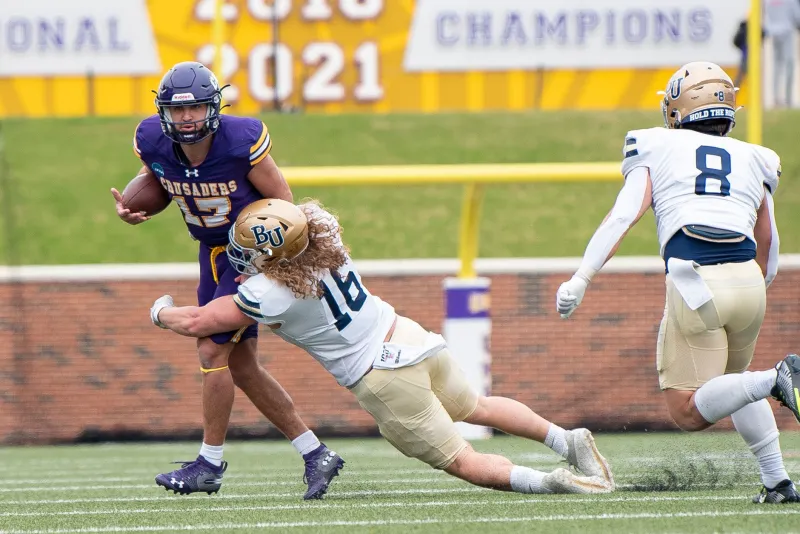
If you've watched more than a handful of college football games in the past few years, you know the feeling. A defender makes a tackle. The crowd holds its breath. The flags come out. The replay review begins. And then — regardless of what actually happened — the announcement triggers either outrage or relief depending on which sideline you're rooting for.
Targeting has become college football's most controversial call, and not for the reasons the NCAA probably hoped when it started expanding the rule. The problem isn't that officials are calling it too much or too little. The problem is that nobody — not coaches, not players, not analysts, not even referees — can reliably predict when it's going to get called. And that unpredictability is doing more damage to the game than the hits it was designed to prevent.
What the Rule Was Supposed to Do
The intent behind targeting was straightforward and genuinely important. Player safety in football, particularly at the college level, is a serious concern. Helmet-to-helmet contact, crown-of-the-helmet hits, and shots to defenseless receivers were causing injuries and, over time, contributing to the broader conversation about long-term brain health in the sport.
The NCAA responded by creating and progressively strengthening the targeting rule, which now carries an automatic ejection for the offending player — and a mandatory review of every call to confirm or overturn it. On paper, that sounds like a responsible framework. In practice, it has become something else entirely.
The Replay Problem Nobody Wants to Admit
Here's where things get genuinely messy. The mandatory replay review was designed as a safeguard — a way to ensure that ejections weren't handed out on bad real-time reads. But the review process itself has become a source of chaos.
The standard for confirming a targeting call requires "indisputable video evidence" that the foul occurred. That language sounds clean, but its application varies wildly. Plays that look identical from the same camera angle get confirmed in one conference and overturned in another. Defenders leading with their shoulder on a clean tackle get ejected while players who genuinely launch headfirst into a receiver walk off without a flag.
Coaches have noticed. A few years back, it became something of a dark art to understand which officiating crews were "targeting-happy" and adjust defensive schemes accordingly. That's not player safety. That's game theory built around officiating inconsistency.
The Conference Disparity Is a Real Issue
If the rule were applied uniformly across college football, the inconsistency would at least be consistently unfair. But targeting enforcement doesn't just vary by game or by crew — it varies measurably by conference.
Data compiled by officiating watchdog groups and sports analytics outlets has shown that targeting ejections per game fluctuate significantly between Power Five conferences. The SEC, ACC, Big Ten, and Big 12 don't operate on the same standard. And when those teams meet in bowl games or the College Football Playoff, the officiating culture clash becomes impossible to ignore.
A defender who plays sixteen games in a conference where physical coverage is routinely allowed suddenly finds himself playing against a crew with a completely different threshold. He hasn't changed how he plays. The rulebook hasn't changed. But the whistle has.
The Ejection Penalty Is Too Blunt an Instrument
Let's talk about the punishment itself, because this is where the rule creates its most perverse outcomes. A targeting call means an automatic ejection, plus a first-half ejection carries over to the first half of the next game. That's an enormous penalty. For context, a player can commit pass interference, hold a receiver on a go route, or take a late shot at a quarterback and stay in the game. But a bang-bang collision that gets flagged as targeting? Gone.
The severity of the punishment is precisely why the inconsistency is so damaging. If targeting were a 15-yard penalty, coaches would be frustrated but functional. Instead, it can take a team's best defensive player off the field for the most important game of the season — based on a judgment call that might get reversed on replay, or might not, depending on the crew and the conference.
We've seen this scenario play out in high-stakes moments. A linebacker gets ejected in the second quarter of a playoff game. The call gets reviewed. It's close. The ejection stands. The defense collapses. And somewhere in the booth, an analyst is trying to explain to viewers why that specific hit warranted an ejection when a nearly identical hit in the first quarter didn't even draw a flag.
What a Better Rule Actually Looks Like
Fix number one: clearer definitions. The NCAA's current language around "targeting" involves terms like "forcible contact" and "defenseless player" that require significant interpretation. Rewrite the standard with specific, observable criteria. Crown of the helmet contact — yes, that's targeting. A shoulder-led tackle where the defender's head happens to make incidental contact? That needs a higher bar.
Fix number two: tiered penalties. Not every targeting foul deserves an ejection. A graduated system — where a first offense in a game draws a 15-yard penalty and a second offense triggers ejection — would still create meaningful deterrence while preventing the catastrophic outcome of losing a player for a borderline call.
Fix number three: centralized replay review. The current system has conference officiating offices reviewing calls in real time. A single, centralized review office — like the NFL's setup — would create more uniform application of the standard. At minimum, it would reduce the conference-to-conference disparity that makes the rule feel like a different game depending on where you play.
Fix number four: formal post-game accountability. The NFL releases last-two-minute reports that assess specific calls. The NCAA has no equivalent. Creating a public record of targeting calls and their accuracy — reviewed against a consistent standard — would at least generate the kind of accountability pressure that tends to improve consistency over time.
Safety Matters. So Does Getting This Right.
None of this is an argument against protecting players. The targeting rule exists for a legitimate reason, and the sport is better off having it than not. Dangerous hits at the college level are a real problem, and the culture of physicality that sometimes celebrates those moments needs to be checked.
But a rule that's applied inconsistently isn't just unfair — it's also ineffective. If defenders can't reliably predict what's going to get called, they can't reliably adjust their technique. The rule stops being a behavioral guide and starts being a lottery. And a safety rule that functions like a lottery isn't protecting anyone. It's just creating a different kind of chaos.
College football deserves better than that. The players being ejected deserve better. And frankly, so do the players the rule was designed to protect.