Ghost Blocks and Phantom Flags: The NFL's Holding Problem Is Out of Control
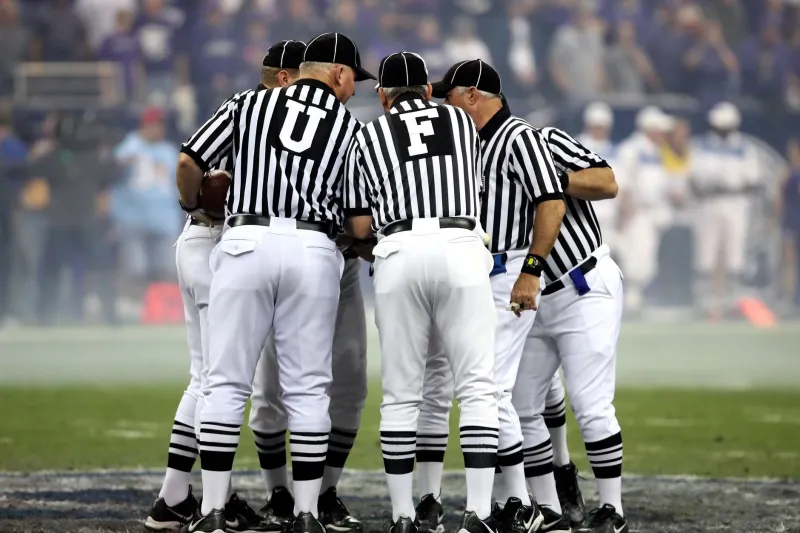
Here's a fun experiment. Pull up any NFL game from the last three seasons, pick a random offensive line play, and watch the hands. Really watch them. You'll see jersey grabs, arm locks, and body wraps that would make a WWE referee blush. Now ask yourself: how many of those got flagged?
Maybe one. Maybe none. Maybe — on the exact same drive — a guard on the other team got called for something you literally cannot find in the replay.
Welcome to the most inconsistent, most frustrating, and most consequential officiating problem in professional football. Offensive holding isn't just a judgment call anymore. It's a choose-your-own-adventure book where refs seem to be writing entirely different stories depending on who's playing, what quarter it is, and — frankly — who knows what else.
Every Play Is a Holding Penalty Waiting to Happen
Let's start with the uncomfortable truth that everyone in the league already knows: offensive linemen hold on virtually every snap. That's not hyperbole. Former officials have said it publicly. Coaches whisper it. Players know it. The rule, as written, prohibits using hands or arms to hook, lock, clamp, or otherwise restrict a defender's movement — and if you enforced that to the letter, you'd be throwing a flag on about 80 percent of NFL plays.
So the league has always relied on refs to exercise discretion. Fine. That's not a new concept in sports. But discretion is supposed to mean applying a consistent standard, not spinning a wheel.
The problem is that the standard has become so blurry that it's essentially nonexistent. And when the standard disappears, what fills the void is something a lot uglier: inconsistency that starts to look a whole lot like bias, whether intentional or not.
The Numbers Tell a Story Refs Won't
Dig into holding penalty data from the past few seasons and patterns emerge that are genuinely hard to explain through randomness alone. Certain offensive lines — particularly those attached to high-profile, nationally televised franchises — draw holding calls at rates significantly lower than mid-market teams with comparable or even cleaner technique. Meanwhile, some pass rushers who are elite enough to regularly beat their blocks somehow generate far fewer holding flags than their production would suggest they should.
Then flip to the other side: there are offensive linemen who seem to get flagged for blocks that, on replay, look completely legal. Hands inside the frame, no restriction of movement, no jersey pull — and yet the yellow flag is already in the air before the play even develops.
Statistical analysts covering officiating trends have noted that holding penalties spike in specific game situations — third-and-long, late in close games — at rates that don't match early-down frequencies. That's either a remarkable coincidence or evidence that refs are making calls based on situational pressure rather than actual infractions. Neither explanation is particularly comforting.
The Film Doesn't Lie — But the Flag Does
Breaking down game footage is where this whole thing gets maddening. Take a contested playoff game from recent memory — any one will do — and slow it down to the offensive line matchups. On plays where no flag is thrown, you'll routinely see textbook holding: a tackle's outside hand drifting to a defender's shoulder pad and locking, a guard's arm wrapping around a linebacker's torso to cut off pursuit. Clean? Absolutely not. Called? Nope.
Then, three plays later, a flag drops for what the broadcast crew can't even identify with confidence. The analyst stammers through an explanation. The color commentator says something diplomatic. And ten yards get walked off anyway.
The disconnect between what's happening on the field and what's getting flagged has become so wide that offensive coordinators are now essentially factoring holding penalties into their game plans as a variable they can't control — like weather or a bad turf field. That's insane. A core rule of the game has become background noise.
Is There a Quota? Or Just Chaos?
One theory that circulates among coaching staffs — quietly, because nobody wants to get fined for criticizing officiating — is that refs feel pressure to balance flag counts throughout a game. Call three on one team in the first half, and there's an unspoken nudge to even things out in the second. It's not a written policy. It might not even be conscious. But the pattern shows up often enough that it's hard to dismiss entirely.
Another theory is simpler and maybe more damning: refs just aren't well-positioned to see holding consistently. The NFL's officiating crew assignments put certain officials in spots where offensive line play is genuinely difficult to evaluate in real time. A bang-bang hold on the backside of a run play, away from where the ball is going, is almost impossible to catch accurately at full speed. So sometimes they call it. Sometimes they don't. And the determining factor might just be which direction the ref happened to be looking.
If that's the case, the solution isn't about bias — it's about structural failure. And the league has had years to fix it.
Why the NFL Won't Touch This
Here's the cynical read: the NFL doesn't want to fix holding enforcement, because truly consistent holding calls would fundamentally change how the game looks. You'd see drives stall out more. You'd see sacks go up. You'd see the pass-happy, high-scoring product that TV networks pay billions for get a lot messier.
The league has a vested interest in offensive production. Quarterbacks are the stars. Touchdowns drive ratings. A holding call that kills a fourth-quarter touchdown drive isn't good television, and the NFL is, above all else, a television product.
So the incentive to clean up enforcement isn't really there — not at the organizational level. What you're left with is a rule that exists primarily as a threat, deployed selectively enough to feel meaningful but loosely enough that it never truly constrains offensive play.
The Fix Nobody's Asking For
If the league wanted to get serious, the path forward isn't complicated. Assign a dedicated official specifically to watch offensive line play on every snap — a role that doesn't exist in the current seven-man crew structure. Use replay review for egregious holds the same way pass interference was briefly reviewable (yes, that experiment was a disaster, but the concept of accountability isn't wrong). And publish officiating grades that include holding call accuracy, not just the vague performance reviews that currently disappear into the league's internal review black hole.
Will any of that happen? Almost certainly not. The NFL moves at a glacial pace on officiating reform, and holding is the kind of issue that generates fan frustration but not the kind of public pressure that forces action.
So for now, offensive linemen will keep holding. Refs will keep calling it when they feel like it, missing it when they don't, and occasionally flagging plays that nobody can explain. And fans will keep rewinding their DVRs, squinting at freeze frames, and asking the same question that never gets a straight answer:
What exactly did they see?